




 |
| Exhibition of Work by Creative Arts Students from Coleg Meirion-Dwyfor, now on, until 3 August... Followed by: 'Processed Memory': Photographs by Remy Dean from 7 August - 7 September. Alongside the photographs, there will also be a small exhibition of 3D work by the potter Jane Williams Opening hours and gallery info here... |

.jpg)

.jpg)
NEWS: This, That, and The Other has made its web novel début on Substack.
Free to read for now. Paid subscriptions will be switched on later this year.
All those who have taken up the free subscription before that date (TBA)
will be offered a significant discount.
↓ NEW ↓
Friday, 5 July 2013
Summer Exhibitions at Oriel Maenofferen Gallery
Tuesday, 28 May 2013
Two Fine Painters at the Royal Cambrian Academy
...well worth a look...
The current exhibition at Conwy's Royal Cambrian Gallery is a 'two-header' of very different and very accomplished painters who are using painted pigments to emulate the transient beauty of light and life.
In the ground floor gallery space you have an opportunity to see stunning landscapes by Harry Robertson, including one of the best paintings of a moody Welsh waterfall I have seen. Robertson certainly manages to capture the movement of light across the land and the way the pattern of sunshine and cloud-shadow alters the texture and detail. 'Detail' is a word that comes to mind again and again when looking at his meticulously executed work - his selection of what details to include and which to leave out lends a photographic realism that also manages to hint at a much deeper poetic response. If you like landscape painting, you would be 'hard-pushed' to find better than these... (Though fellow Royal Cambrian Academy artist Gerald Dewsbury could be a contender.)
John Baum's large colourful canvasses can be viewed in the upstairs gallery - another painter that loves the play of light - and loves to play with light... mainly naturalistic portraits against an artificial setting, these works are then built up with daubs of bright sunny colours that push the photo/graphic representation towards abstract composition, whilst remaining realist and keenly observed. The clean lines and use of spaces in these scenes brings to mind the work of a happy Edward Hopper. It appears that Baum has found a style of work that suits his artist's eye - a departure from much of his earlier portrait works that were simply fiercely lit figures against flattened photo-real backgrounds - and I find the paintings currently on show much more engaging and uplifting (not only because there are also a few nicely observed dogs).
...Harry Robertson and John Baum exhibition until 6 July...
After that, your best bet for top-notch landscape painting (and other work) would be the Rob Piercy Gallery in Porthmadog. The cosy, friendly gallery hosts a permanent exhibition of oils and watercolours by Piercy and a selection of work by other local artists who connect with the land, such as Bill Swann, who works mainly with glass...
Friday, 10 May 2013
A Pair of Beautiful Blogs
Silent Beauties – just fantastic, I don’t know how they manage to find so many rare,
lost and abandoned little films, let alone how they then find time to upload
them! Though the focus is on the more obscure films that are not represented elsewhere, this is one of the most active blogs on my blogroll, there’s always
something new, well actually it’s usually something old, of course…

This blog will evoke nostalgic pangs in many readers, of a certain age, but can snap them out of it with content that brings them bang up to date with what is happening in cult media today. The writing is intelligent and perceptive and will approach popular programmes, and overlooked classics, with the same sort of critical respect usually reserved for those high-brow ‘arty’ films… if you are studying media make sure you have a read of this before you tackle any of your essays. The main thing that makes this a most rewarding read is not its clear and flowing style (which is abundant), but that it enhances enjoyment – for example, try watching an episode of Doctor Who, then read the review and watch it again. You will see what I mean…
It is
astonishing that this is a privately administrated site run by enthusiasts, it
appears more like a ‘National Archive’ of some specialist museum or university,
except that the content is of international interest and value. The majority of
the content is, as the name suggests, silent movies and early documentary films
and being without sound these easily bridge the language barriers. This is a
huge resource and one of the most valuable media blogs on the www – really
useful for teachers and cultural historians and just really interesting for
personal perusal… check it out for some ‘quiet time’.
If you prefer
your media with sound, why not try:
Cathode RayTube – another site that fills me with awe and admiration at the sheer volume
and quality of the content that regularly uploads. This is the blog of the
erudite Frank Collins, a long established ‘critic’ and general fount of
knowledge for cult TV and genre cinema, particularly British SF and Horror, but
he also casts his roving eye over comedy and classics.
This blog will evoke nostalgic pangs in many readers, of a certain age, but can snap them out of it with content that brings them bang up to date with what is happening in cult media today. The writing is intelligent and perceptive and will approach popular programmes, and overlooked classics, with the same sort of critical respect usually reserved for those high-brow ‘arty’ films… if you are studying media make sure you have a read of this before you tackle any of your essays. The main thing that makes this a most rewarding read is not its clear and flowing style (which is abundant), but that it enhances enjoyment – for example, try watching an episode of Doctor Who, then read the review and watch it again. You will see what I mean…
Thursday, 21 March 2013
David Bowie Is (was and always will be)
...so who was Ziggy?
(the following entry is an extract from the book Evolution of Western Art by Remy Dean)
 Oscar Wilde said, “Man is least
himself when he talks in his own person. Give him a mask, and he will tell you
the truth.” The character of Ziggy
Stardust was created and played by David Bowie – a parallel personality that is
both fictional and biographical. With the 1973 album, The Rise and Fall of Ziggy Stardust and the Spiders From Mars,
Bowie examines the outsider role (roll) of rock stars, and other such artists:
characters that exist in extremis for
the vicarious enjoyment of the mass audience, an audience who may fantasise
about living such a lifestyle, yet welcome the ultimate ‘morality-tale’ (self)
destruction of such characters.
Oscar Wilde said, “Man is least
himself when he talks in his own person. Give him a mask, and he will tell you
the truth.” The character of Ziggy
Stardust was created and played by David Bowie – a parallel personality that is
both fictional and biographical. With the 1973 album, The Rise and Fall of Ziggy Stardust and the Spiders From Mars,
Bowie examines the outsider role (roll) of rock stars, and other such artists:
characters that exist in extremis for
the vicarious enjoyment of the mass audience, an audience who may fantasise
about living such a lifestyle, yet welcome the ultimate ‘morality-tale’ (self)
destruction of such characters.
(the following entry is an extract from the book Evolution of Western Art by Remy Dean)
Ziggy has clear parallels with
Thomas Jerome Newton, a character created by Walter Tevis in his 1963 novel, The Man Who Fell to Earth. This strong
connection landed Bowie Bowie
In this way the concept of
Ziggy Stardust can be seen as a result of creative collaboration and as part of
a cycle that ‘feeds-back’ into complementing one of its influences. This is a
fine example of Post-Modern cross-referencing and could also be seen as a near
definitive work of Pop Art. The concept spans across different mass media –
literature, popular music, theatre, cinema – and spills into the secondary
cultural network of criticism, reportage and hype. Ziggy Stardust became
established as a character of modern mythology.
 |
| "Mr Newton has had enough..." David Bowie in The Man Who Fell to Earth |
In Bowie Newton
Thomas Jerome Newton is
definitely an alien who has been sent to Earth in a last-ditch attempt to save
his own parched planet of Anthea. His mission is either to prepare the earth to
receive his planet’s refugees, or construct space vessels capable of
transporting much needed water back to his homeworld. He quickly builds an impressive
business portfolio of cutting-edge technology companies and products, though
also begins to realise that he will be unable to complete his mission.
Poignantly, he writes songs and records groundbreaking electronic rock music
that he hopes will carry his lyrics out into space where his distant family
will, perhaps, hear his voice once more…
With Ziggy Stardust, David
Bowie created the template for the Modern rock star. He was image-conscious in
his public projection, utilising theatrical make up and costume design. His
definitive manifestation of Glam Rock played with gender ambiguity and
contrasted this with ‘cock-rock’ posturing. He changed the face of rock’n’roll,
elevating it to an art form and setting a benchmark for those who were to
follow, also foreshadowing important transmedia genres such as Cyberpunk and Futuregoth. Ziggy Stardust remains a pertinent multi-media ‘essay’ about ‘The
Other’ and otherness.
More Bowie stuff here...
More Bowie stuff here...
Tuesday, 11 December 2012
2012... that was
Yuletide greetings
and all the very best
for 2013, Year of the Serpent!
+
dates for the diary:
This summer, 7 August - 7 September 2013, there will be an exhibition of photography by Remy Dean at at Oriel Maenofferen Gallery, Llyfrgell Blaenau Ffestiniog Library, Canolfan Maenofferen, Blaenau Ffestiniog, LL41 3DL. Telephone: 01766 830415.
and all the very best
for 2013, Year of the Serpent!
+
dates for the diary:
This summer, 7 August - 7 September 2013, there will be an exhibition of photography by Remy Dean at at Oriel Maenofferen Gallery, Llyfrgell Blaenau Ffestiniog Library, Canolfan Maenofferen, Blaenau Ffestiniog, LL41 3DL. Telephone: 01766 830415.
Monday, 17 September 2012
Fantastic Feedback
'Adventures in Feedback', an
exhibition of recent work by Mark Eaglen is currently on show at Galeri Caernarfon. A couple of the smaller pieces were ‘premiered’ last year alongside
my ‘Night / Light’ photographs at Oriel Maenofferen, and those small but
beautifully formed sculptural pieces were just a hint of what was to come from
the mind of Mark in the twelve months since. Some of the work you will see in
this current show is not actually there…
Eaglen is a
technomage, merging lo-fi audio-visual technology and high-brow showmanship. The
work is highly personal, yet the yearning nostalgia for analogue and childhood
wonder will resonate with many. The ‘Transmission Call’ holographic piece brings to
mind afternoons rushing back from the shops and eagerly awaiting the television
picture to ‘warm-up’ as we listened to the recap from the previous week’s episode
of ‘Doctor Who’. The sculpture is a simplified 1970s TV set laying on its back,
as if discarded at a particularly clean and respectful recycling depot. As the
viewer approaches it, the dark screen seems to exude a faintly glowing form,
the reaction of the viewer attracts the attention of those nearby, who of
course cannot see the same thing unless they too come closer. They are drawn to
this holographic ‘sculpture’ that floats above the screen like a ghost image,
as intangible as a memory.
Other works
on show include series of intricate little drawings that shimmer with silvers.
Again, the viewer must experience these, first-hand, as they will not translate
easily through scans or prints and even these change, depending upon the
position of the viewer and the angle of light. There are some audio-visual works and an interactive piece
that uses video cameras and projectors to create a feedback loop that you can
play with, providing endless delight for children and the child within us all –
and again, no two experiences of this subtle work will be the same. There are many
tiny delicate forms and a larger wire mesh sculpture that creates a feedback
pattern in the eye of the beholder as they approach the form. It looks like it
could be a scientific model of something organic.
Like most
of the work here, this piece is an exploration of feedback and its form has
been created by recording an (analogue) feedback pattern, selecting a ‘frame’
and then assigning the colour and tonal values a three-dimensional depth using
a (digital) computer. This three-dimensional ‘graph’ has then been converted to
a hologram and now appears as an object that does not really exist.
It relies
on basic interaction with the viewer, who has to stand in a particular place in
order to see the complete picture. The person stood next to them will see
something slightly different, in much the same way as no two people see exactly
the same rainbow. I am reminded of the time I saw Marcel Duchamp’s kinetic
sculpture from the 1920s titled, ‘Rotary Glass Plates (Precision Optics)’, at
the Museum of Modern Art Barcelona
Duchamp was
the first artist to really start examining art as a process and to really
recognise it as an ongoing ‘conversation’ between the artist and the wider
social circle of the audiences. Though nearly all art relies on some sort of
object, the art is not that object. The art begins in the mind of the artist, and
then continues in the mind of the viewer. The object is a medium. By focussing
on feedback, Eaglen has extended this consideration of process into another ‘loop’:
an artist does not create in an isolated ‘bubble’, they are a product of the
way that their mind interacts with, and is influenced by, many aspects of the
culture that surrounds them. By exhibiting their work, they are presenting it
to that wider culture which, to a lesser or greater extent, is then altered by
its presence. That altered culture is, in turn, experienced by the artist. A
feedback loop has begun.
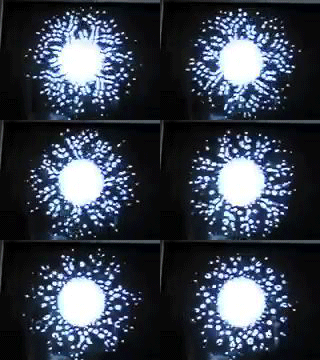 |
| above: an example of optical feedback from Wikimedia Commons |
Although the
art space at the Galeri is small and oddly shaped, this exhibition fits perfectly
as it has lots of small detail, cleanly and elegantly presented. It is not a
large exhibition, but it will reward the viewer who spends time to engage with
it. The lasting impression that I came away with was a simple beauty born out
of chaos and complexity.
You can see
examples of Mark Eaglen’s work at his website here...
Or go to
the Galeri website for more information about his current exhibition.
Wednesday, 18 April 2012
'Evolution of Western Art' by Remy Dean - NEW Book
Firstly, thanks to all who took advantage of the free downloads offer from amazon Kindle store on World Book Day. If you get the time to read either Final Bough and/or Scraps, I hope they are sufficiently entertaining...
My new non-fiction book is now also available (as from today) - alas not for free, but for a very reasonable price. It is a ‘history of art’ text book called, Evolution of Western Art by Remy Dean.

It is a text book supported with a dedicated weblog: http://dean-evolution.blogspot.co.uk/
Publisher’s Product Description:
'Evolution of Western Art' by Remy Dean is an essential resource for the art student, novice practitioner and general art enthusiast who would like to expand their knowledge, and enhance their appreciation, of art.
This fresh approach to art history follows a timeline that spans more than 40,000 years, from pre-history to the present day, using clear language and specific examples to chart the development of key ideas and major concepts along the path. Art is the ultimate expression of a culture and often survives as the only evidence of how people thought and acted. Could art be one of the factors that saved the human race from early extinction? Do we make art because we are intelligent, or has human intellect grown as a response to our art? How does our art define us?
This text book has been developed by a teacher with more than a decade’s experience of lecturing in art history and contextual understanding to young adults (levels 2, 3 and 4). The aim is to remain clear and concise without over-simplification and not shy away from the important concepts. Each example is approached using a method of analysis suited to the work.
This book guides the reader along a path that runs through the major landmarks in the evolution of western art. It takes in ancient art, mediaeval art, the Renaissance, Baroque, Rococo, the art of the Enlightenment, the Romantics, Impressionists, Expressionists, Modernists, the Abstract, the Post-Modern, the Conceptual and the contemporary scene…
My new non-fiction book is now also available (as from today) - alas not for free, but for a very reasonable price. It is a ‘history of art’ text book called, Evolution of Western Art by Remy Dean.
Click image of the cover above to find out more
It is a text book supported with a dedicated weblog: http://dean-evolution.blogspot.co.uk/
Publisher’s Product Description:
'Evolution of Western Art' by Remy Dean is an essential resource for the art student, novice practitioner and general art enthusiast who would like to expand their knowledge, and enhance their appreciation, of art.
This fresh approach to art history follows a timeline that spans more than 40,000 years, from pre-history to the present day, using clear language and specific examples to chart the development of key ideas and major concepts along the path. Art is the ultimate expression of a culture and often survives as the only evidence of how people thought and acted. Could art be one of the factors that saved the human race from early extinction? Do we make art because we are intelligent, or has human intellect grown as a response to our art? How does our art define us?
This text book has been developed by a teacher with more than a decade’s experience of lecturing in art history and contextual understanding to young adults (levels 2, 3 and 4). The aim is to remain clear and concise without over-simplification and not shy away from the important concepts. Each example is approached using a method of analysis suited to the work.
This book guides the reader along a path that runs through the major landmarks in the evolution of western art. It takes in ancient art, mediaeval art, the Renaissance, Baroque, Rococo, the art of the Enlightenment, the Romantics, Impressionists, Expressionists, Modernists, the Abstract, the Post-Modern, the Conceptual and the contemporary scene…
Subscribe to:
Comments (Atom)


 Posts
Posts

