NEWS: This, That, and The Other has made its web novel début on Substack.

Free to read for now. Paid subscriptions will be switched on later this year.
All those who have taken up the free subscription before Summer Solstice
(21 June 2026) will be offered a significant discount.


Showing posts with label Mark Eaglen. Show all posts

Wednesday, 30 September 2015

When Corky Met Sparky – The Haus of Helfa Journals (part 4)

[start with part 1]

Moonshadows slowly stretched across the valley, though they were shed by no ordinary full moon. It was a harvest ‘supermoon’, about to be painted blood-red by the combined refracted sunsets of our planet… What a great cosmic finale to Haus of Helfa 2015…

It had begun on the day of remembrance for Hiroshima - a glaringly bright and dark-stained chapter of Earth history - and ended in this humbling and beautiful global event. The stars shone brighter as the lunar light dimmed. I imagined standing on our (not-so-) distant sister satellite, watching the dark earth all but obscure Sol, save for its rosy halo setting our slight atmosphere aglow, uniting, encompassing us all in the endlessly black, star-stabbed sea of space…

Well, I thoroughly enjoyed this year’s Haus of Helfa, and judging from the reactions of the many visitors, so did a lot of other people. On behalf of the thirteen artists in ‘da haus’, a big “Thank you!” to all those who came to have a look and get involved. I particularly appreciated the many stimulating chats about some very deep creative concepts…

Doors opened to the public every weekend in September
It has been a new experience for me, mingling with such a group of artists as they progressed their processes from conception to construction. One thing that quickly became apparent was how hard they worked, some more physically with hammer and nails, others intensely with bespoke tech, some internally, emotionally, intellectually… Whatever their method, it was obvious they cared: About the work; About how they were expressing themselves (we all know artists are self-absorbed, right?); but above all - perhaps more surprisingly - about what marketers would call, ‘the end-user experience’.

We love our audience…

There was a healthy creative atmosphere of competition, with no sense of rivalry, as each saw the others develop their varied outcomes, aware of what was in the next space. In this way, although each room contains a separate piece of work, the house itself does have a sense of, not quite collaboration, but a definite cohesion - perhaps owing much to the input of curators Sabine Cockrill and Marc Rees.

So, what were the motivations of all involved?

Although reasonable material costs were covered - and it was like being ‘given’ a studio, rent-free, for two months - this residency was not fee-paying. Sure, administrators were paid, but the artists were not! So the artists were doing this because they wanted to – that simple. This goes to show that, given half a chance, creatives will just get on with it. Driven by a need or a desire within, they will work very hard and consistently to produce something that can only enrich the local, and wider, communities. The success of Haus of Helfa has relied completely on this ‘generosity-of-the-self’ – it is a gift, from those artists involved, to us all.

Lucky for our contemporary culture, true art (whatever that may be in your opinion) is not money-motivated. So, what wonders would we witness, if more funding allowed artists the creative freedom that Haus of Helfa has offered… and what if…

What if more creatives were afforded the time and space to create?

This residency, sometimes referred to as the ‘flagship’ of the Helfa Gelf Art Trail, is now an essential part of Llandudno… and the diverse cultures of Wales… A little like Yuletide, it comes round but once a year, and as soon as it is over, we can only look forward to the next!

Until then, here is a brief recap and overview of what happened in ‘da haus’…

It is not over - until it is over

Through August, in the run-up to the residency, I started the writerly ball rolling by posting a song per day on twitter, themed around writing and writers. (Click here for these songs gathered as a YouTube playlist.)

Also via twitter, I broadcast a series of eight #WordsOnWednesday - these were linked with the objet on display in my ‘vitrine’ and with jottings lifted from my notepads and sketchbooks:

Words On Wednesday # 1photograph and text by Remy Dean
Words On Wednesday # 2photograph and text by Remy Dean

Words On Wednesday # 3photograph and text by Remy Dean

Words On Wednesday # 4photograph and text by Remy Dean
Words On Wednesday # 5photograph and text by Remy Dean

Words On Wednesday # 6photograph and text by Remy Dean
Words On Wednesday # 7photograph and text by Remy Dean

Words On Wednesday # 8, photograph and text by Remy Dean

During the residency, I invited visitors to send themselves a postcard in response to a set of three stimuli. Thanks to those who did – click on the image below to see a mini-gallery of some of the results…

Notes to Selves: visitor-penned postcards on display in Haus of Helfa
I experimented with the gesture of writing as a form of drawing, trying to find common ground for writing and visual art to cohabit. The results are being gathered into a book, Scanner - Printer. This was briefly covered in my Haus of Helfa Journals (part 3) entry, and some of the results will also be shown later this year, in my forthcoming exhibition at Oriel Maenofferen, Entropy / Extropy.

My exploration of attaching stories to artefacts took the form of 'Corky', the Cicorc Conwy. He was on show in my Haus of Helfa space and generated lots of interesting and delighted conversations from visitors of all ages. Grown-ups were charmed and children were highly engaged, even making up some cicorc stories of their own - unprompted - to tell me! In all, a surprisingly successful exercise in getting a piece of fiction across to a very varied audience. This experimental method of story-telling is something I will, definitely, be exploring further.

Corky (Left) was allowed out of his box to meet Sparky!
…and as my sixth response to the residency, I kept fairly extensive on-line Haus of Helfa Journals – this is that, it is (you are reading part 4 right now)…

I have already mentioned most of the art and a happenings that occurred, in previous posts here (part 1 + part 2 + part 3), though, since the last entry, the major event known as Llawn03 occurred.

Celebrating a colossal concoction of camp and creativity(!), the Llawn Festival is the biggest arts event in the North of Wales in general, and for Llandudno in particular. Over the weekend of 18 – 20 September, artists, performers, and guests from Wales, Europe and the World, descended on the historic seaside resort town to express and enjoy a multitude of… things: art, objects, events, open air cinema, poetry, comedy, stories, singing, dancing, bingo, abseiling, bathing, contraptions, knitting, automatons, food, drink, sunshine, sea and sand – not necessarily in that order. Something for anyone and plenty for everyone.

At the Haus of Helfa, things got well and truly underway at 8 o’clock, when guests from the official Llawn03 launch at Oriel Mostyn arrived to take full advantage of the free bar and chat with the resident artists and each other.

Full (Art) Haus!

Alan Whitfield hosted a session of Austerity Bingo. Sitting at the front of a gloriously camp bingo set, wearing a gloriously camp blue sequinned jacket, he took on the mantel of a northern bingo caller, veering from cheeky’n’cheery to grumpy’n’angsty. Whenever a ‘lucky-number-seven’ came up, he was compelled to recite a fragment of poetry, revealing thoughts and feelings otherwise hidden behind the repetitive act of calling out random numbers. (“89, your grandmother’s Welsh.”) Sat before him, at the rows of formica-topped, wood-effect tables, guests dabbed red dots, looking for patterns and meaning where there were none, and hoping for the luck-of-the-line or even a ‘Full House’ to win suitably austere prizes.

Alan Whitfield gets the bingo blues and channels the Tedder House binghosts
It was both surface and symbol. The thin gaud of tacky glamour veiling the dusty raw brickwork, the scratched and pierced veneer covering the table-tops, the meaningless numbers given a semblance of order in rigid grids, the repetitive acts of number-calling and number dotting unifying the MC and the punters… The same actions, over and over, for no other goal than the brief respite of a random player winning a random prize. Meaningless monotony disguised as fun with the promise of reward… This was play, but sounds more like a working life. Then again, most of the players were just cheerfully enjoying!

Camping Out in Llandudno

Later that evening, Whitfield’s Bingo Hall provided the perfect setting for the light entertainment in the delightful form of Divina DeCampo (aka Owen Richard Farrow), a drag act with a difference: a fairly gentle and civilised sense of humour that did not play down to the bitchy stereotype, and a genuine voice talent! Whether drag acts are your cup of tea or not, this was ‘top entertainment’ in the fine tradition of seaside resorts. There was fun to be had at no-one’s expense. For me, Gilbert and Sullivan light opera is anathematic, but Divina kept just on the right side of send-up, whilst doing professional justice to the highs and lows. The more raucous Broadway hits were also pitched perfectly between parody and proper performance. I felt like I was back in Blackpool…  The between-song banter with the audience was witty without vindictiveness. Although everything else was suitably false, the warmth and talent was not.

As the wine ran out, the Friday night launch drew to a close. The last thing I remember is photographer David McBride and a guest, Mark, having an ‘ambient-off’ using their smartphone playlists involving Byrne, Bowie and Eno… Then I had a short walk to the Llandudno Travelodge, which is so new it still smells like a table-tennis bat.

The remainder of the Llawn03 weekend was by far the busiest and, though I was mostly in the Haus of Helfa Bar, I did manage to sneak out to the Tabernacle Vestry to have a look at the installations there by two artists that had been Haus of Helfa residents last year…

The Artful Spirit

Angela Davies had set up a rotating, under-lit column of rods and lenses that acted as a vertical projector. One of the lenses was interchangeable and could be swapped for others that had been hand-crafted in blown glass. The images they projected onto the ceiling-mounted, circular screen were evocative of the macro- and micro- cosmic. Could this be a planetarium showing us distant planets and nebula? Are we seeing, “the transient creatures that swarm and multiply in a drop of water”? Or, given the setting, are these vitrified visions of spirits and angels? A beautiful and mysterious abstract that uses light itself and the process of seeing as its media.

Seeing the light - Angela Davies' installation in the Vestry
Venturing further into the vestry, we find Mark Eaglen, technomage, who is showing Transmission Call, his ‘cutting-edge-retro-TV-hologram’. This is a sculpture suggesting a simplified 1970s TV set laying on its back, lazily rotating in the tight beam of a single spot lamp. As the viewer approaches, the dark screen seems to exude a glowing form, the reaction of the viewer attracts the attention of any others in the vicinity, who of course cannot see the same thing unless they too come closer. They are drawn to this holographic ‘sculpture’ that floats above the screen like a ghost, as intangible as the memory of something they may have seen on the telly of their childhood. I had seen this piece before, though this time it was displayed much more effectively and the rotation and controlled lighting made the ‘ghost’ seem more substantial. Visitors reacted with the same playful curiosity and saw different things in the illusory 3D form. Some saw magnified crystal lattices, some saw desert landscapes or the surface of other worlds… endlessly rotating and endlessly fascinating.

These two pieces were not collaborative, though shown side-by-side in the vestry space, there was an undeniable dialogue between them. Slowly spinning and suggestive of great and small, using the properties and behaviour of light itself as an integral part of the works. This was a very good example of what Llawn03 is all about – using unusual spaces to showcase art. The old playing host to the new. What a beautiful discovery for the visitor following the festival guide - to wonder through a fairly unremarkable little door, down the side of an old church, and find such a poetic experience awaiting them!

Moving House

Around the back of the condemned Tudno Castle Hotel (where the furniture for the Haus of Helfa Writers’ Bar had been rescued from) another discovery awaited. Appearing at first to be a builder’s tarpaulin draped on scaffolding, we are drawn to what we soon discover is a huge and incongruous, rubbery crimson cast, of a house… a house that is conspicuous by its absence.

Getting under the skin - this is a Sobbing House, a house in which to sob...
This is an installation by Eli Acheson-Elmassry, titled, Sobbing House, a full size cast of her own home’s façade. It is obvious that the house this ‘skin’ belongs to is elsewhere, and so a dialogue of distance begins – where is the house? Has it been demolished from under this cast, or has the cast been moved here from another location? At first it seems great fun, like a huge one-sided tent or a playhouse for the shadows of trees and visitors cast through the brightly translucent skin by the low sun. Though we must bring ourselves to consider the title. The structure appears to breathe with the breeze and this motion could suggest sobbing, the blood red colour is indicative of the flesh - flayed and displayed, and obviously there is the reference to displacement and relocation. The artist has dedicated this piece to refugees, so the fun stops there and the piece becomes a poetic statement about the home and the homeless.

Another Man's Treasure

On the way back to the Haus of Helfa, we stopped by the Royal Cambrian Academy’s outreach expo, in a shop just along from the Mostyn Gallery. Here we saw some automatons on show: an antique pram that ceaselessly moved back and forth, a mannequin rotating on the spot and a motor that pulled a piece of iron girder up and down in an old cot. There was also a dolls' house painted a very similar crimson to the Sobbing House, perhaps as a homage. This imagery was lifted from the paintings of Shani Rhys James and explored themes of motherhood and the oppression of women and ‘home-makers’ - perhaps?

Dwsin - the treasured objects of  (L-R) Marc Rees, Philip Hughes and Steffan Jones-Hughes
At the back of the shop was an interesting installation of three brightly painted cabinets displaying sets of objects selected by three curators, Marc Rees (Llawn's very own), Philip Hughes (of Ruthin Craft Centre) and Steffan Jones-Hughes (of Oriel Wrecsam). Each had been asked to select 12 items that have had a big influence upon their lives and their work. (Though I noticed that one had cheated and included 13 – a baker’s dozen again!) They self-curated their own treasured objects and explained the significance of their choices in an accompanying video.

This trilogy of assemblages was visually interesting and also contained unique biographical narratives. I appreciated the strong correlation with my own exploration of how words and associated objects accrue meaning additional to, and more complex than, their literal interpretations - such as BISCUIT, on show in the ‘vitrine’ back at the Haus of Helfa. It also reminded us that exhibitions and events such as Llawn, Helfa Gelf and Haus of Helfa, come about as the results of curatorial energies, selections and developments. Hats off!

All that is left...

The Llawn03 weekend blurred by and left one more final weekend to reflect and consolidate the whole gamut of experiences during the residency. I was glad that Sparky, the ‘traditional Prague upholstery dog’ (and my art-tours ‘mascot’, whom regular readers of this weblog may recognise) visited to meet ‘Corky’ the ‘traditional Conwy cork dog’, and had a good look round…

Coming soon: Sparky's Adventures in the Haus of Helfa... (watch this space)

MORE:


Sunday, 7 September 2014

Meet the Residents of Number 26, Past, Present & Future...

You may think it looks like an empty house, but we found out that such an assumption would be incorrect. Venture inside and there is not a lot to see at ground level: bare floors, walls hacked back to the brick, some architect’s plans on the far wall showing the layout of the building back in its Victorian heyday… and some paper aeroplanes suspended on slanted nylon chords in the bay window, almost too white in the sunlight and carpeting the dusty floor with their patchwork shadows.

Number 26 Augusta Street, Llandudno, has sheltered many diverse people in its life, including hostel boarders, hotel guests and former RAF servicemen (ah, the paper planes...) and is now a temporary haven for artists, and their art... part of the annual Helfa Gelf Art Trail.

Go up the first flight of raw wood stairs, still smelling of the sawmill, and the dereliction starts to give way to things of interest… in one room there is what looks like a collection of Victorian vitrines awaiting badly needed restoration by some careful museum expert. The ‘bell jars’ contain specimens that appear to be part of an ongoing experiment involving the reactions of fungi with wires and different materials. This is an installation-in-progress by Morgan Griffith aka sonomano. The walls are hung with a few collages that look like they could be from the scientific sketchbook of whatever amateur naturalist, or ‘mad scientist', is conducting the experiments. Their imagery is related to the contraptions on floor and tables, including some more mushrooms. The mushroom metaphor could be a comment on the house, fungi are part of the cycle of decay and new life – the house is stripped down to its ‘bones’ awaiting its rebirth in another form for another purpose…

In the small room opposite, we find Pea Restall and her team constructing a primitive clay cavern, big enough to get inside – this, she explains, is the early stage of an installation that will be enhanced by a low frequency sound sculpture. It is reminiscent of a wood-fired clay oven and also has very wombic, earth-mother connotations…

The big room at the front that links these two spaces has an exhibition of junk sculptures displayed on rough wooden chests and unpainted shelves: bits of broken things and charity shop toys arranged in an abstract way that become more than a sum of the parts.

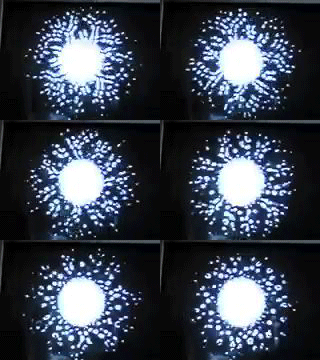
Upstairs again, and you enter a different world, perhaps we have stepped through some sort of time-space portal, a la Doctor Who, into an alien domain where a stranded stranger attempts to reconstruct his space capsule in order to return home – this is the alternative universe of Mark Eaglen (or at least a quantum fragment of it). In one chamber a circular disc pulses with psychedelic patterns that look like time-lapse bacteria multiplying in a petri dish, until you look closer, then the installation assimilates you into its process. Your shadow is captured and, through the inventive use of a video feedback loop, is split and multiplied in an ever changing mandala of light. It is technically baffling, but that does not stop it being huge fun to play with. Toddlers, that have to be steadied on a chair by their parents to reach the beams of light, chuckle with delight whilst the adults impatiently wait their turn.
Welcome to the alternative universe of Mark Eaglen
In the anti-chamber a large light box displays an image of a sphere with an intricate surface. When viewed through the red/green 3D glasses provided, the sphere seems to float free of its surface and inhabit a space a few feet from the wall. What is it trying to show us? A diatom? A grain of pollen, magnified, thousands of times? A cheerleader’s pom-pom? An image of the entire cosmos reduced, billions of times?

You can read my review of an earlier exhibition by Mark Eaglen here...

In the room across the landing, there is the beginning of an on-going response to the building itself from Lisa Carter. War-time photographs are displayed on one wall and a plumb-weight hangs from a long line, suspended inches from the floor, looking rather like a tiny bomb halted moments before impact... Apparently, the house was once home to Baron Arthur Tedder, who devised the method of saturation bombing, known as 'carpet bombing', where large target areas are systematically bombed using grid coordinates.
Building Debris
In the bigger room that fronts this floor of the house there is nothing but bare boards and an empty plinth, on which I elevated a humble piece of the plentiful builders' rubble.

On the top floor, beneath the exposed roofing rafters, we find a room containing some work by Emrys Williams, whose studio is just a few doors away. Here a world of childlike exploration is evoked, model galleons, toy zebras and games are in dialog with his characteristically naïve paintings of quixotic figures and surreal houses. A model duck looks very much at home sat on its nest of straw in the painted fireplace. Text butterflies liberated from the pages of old books are attracted to the light of vents and windows…
Come and play in the wonderful world of Emrys Williams
The room encourages imaginative play, an exploration of an abstract world – we can visualise travelling to far away, exotic places that we may have heard of, but never seen for real. From this bare, unfinished interior, we can know the world in the way we used to as children – our own world inside our heads, almost as real as the world we make up from the memories of places we might have actually experienced…

Crossing the landing, we find a room with some inert audio-visual equipment. A projector, a monitor, some headphones. Still being set-up. For now we can but imagine.

Another small room has a collection of brass fittings and a circle of model railway track laid out in an almost ritualistic way. A light bulb hangs at shin-level from a cable wrapped around a rafter. It could be anything… perhaps some sort of psychic compass to communicate with those spirits that may yet linger in the bricks and mortar… only the artist, Angela Davies, knows what this may become.

In the corner of what would have once been the attic, we find Helen Jones working away on a huge swathe of white material. It looks a bit like a traditional quilt, though she is using distinctly non-traditional methods involving tile-spacers and cable-ties. It resembles a long christening gown, or perhaps the plentiful undergarments of a Victorian lady. There are also some rather ‘inquisitional’ metal structures hung from the ceiling. What is it all about? Helen explains that the metal pieces are based on chastity belts, and the material is meant to evoke Victorian dresses, underwear and the laundry that would have been dealt with, day-in-day-out, by the servants that would have lived in these attic spaces. The white drapery will provide a backdrop to a projected audio-visual piece that will explore and clarify these connections… So for now, I shall think of it as the ‘christening gown’ of the new work, and look forward to returning further along in the residency to see how it all develops.


So, what appears to be an empty derelict house, is actually the birthplace of some fresh and fascinating art installations. The contemporary, high-tech take on materials and processes is beautifully counterpointed by the ‘building-site’ aesthetic of their surroundings. Works by fresh and fascinating local artists that will grow and develop over the next few weeks to become what they will be... in time for the Llawn02 festival.

Reflecting on this, I find my thoughts exploring the many other closed-up empty spaces in Llandudno. Business are closing, buildings stand empty – what a huge waste of resources! Wales has - always has had - a burgeoning creative community. This is showcased by the Helfa Gelf Art Trail, when local artists open their studios and welcome people in to witness their process, and even have a go themselves. It would make sense, would it not, to use more of these spaces creatively? What better way for an estate agent to draw attention to a large property than to allow its space to be used, temporarily, to display locally produced art? Or, even better, to allow up-and-coming (sorry, emergent) artists to work and display in such places… So, kudos to Mostyn Estates for setting this fine example. Surely, there must be other estate agents and property developers that are not really as lacking in imagination as their popular image suggests…

Perhaps we do not have to make space for art and creativity in our lives - the space is already there, standing empty, yet filled with potential, awaiting some creative thinking.

Monday, 17 September 2012

Fantastic Feedback

'Adventures in Feedback', an exhibition of recent work by Mark Eaglen is currently on show at Galeri Caernarfon. A couple of the smaller pieces were ‘premiered’ last year alongside my ‘Night / Light’ photographs at Oriel Maenofferen, and those small but beautifully formed sculptural pieces were just a hint of what was to come from the mind of Mark in the twelve months since. Some of the work you will see in this current show is not actually there…

Eaglen is a technomage, merging lo-fi audio-visual technology and high-brow showmanship. The work is highly personal, yet the yearning nostalgia for analogue and childhood wonder will resonate with many. The ‘Transmission Call’ holographic piece brings to mind afternoons rushing back from the shops and eagerly awaiting the television picture to ‘warm-up’ as we listened to the recap from the previous week’s episode of ‘Doctor Who’. The sculpture is a simplified 1970s TV set laying on its back, as if discarded at a particularly clean and respectful recycling depot. As the viewer approaches it, the dark screen seems to exude a faintly glowing form, the reaction of the viewer attracts the attention of those nearby, who of course cannot see the same thing unless they too come closer. They are drawn to this holographic ‘sculpture’ that floats above the screen like a ghost image, as intangible as a memory.

Like most of the work here, this piece is an exploration of feedback and its form has been created by recording an (analogue) feedback pattern, selecting a ‘frame’ and then assigning the colour and tonal values a three-dimensional depth using a (digital) computer. This three-dimensional ‘graph’ has then been converted to a hologram and now appears as an object that does not really exist.

It relies on basic interaction with the viewer, who has to stand in a particular place in order to see the complete picture. The person stood next to them will see something slightly different, in much the same way as no two people see exactly the same rainbow. I am reminded of the time I saw Marcel Duchamp’s kinetic sculpture from the 1920s titled, ‘Rotary Glass Plates (Precision Optics)’, at the Museum of Modern Art in Barcelona. Duchamp’s piece consisted of sets of glass plates mounted on a motorised drive shaft. On the plates were arcs carefully painted to create partial circles. When the motor switches on and spins the plates, it creates the illusion of concentric circles hovering in the air – this illusion only works for those stood one metre directly in front of the machine.

Duchamp was the first artist to really start examining art as a process and to really recognise it as an ongoing ‘conversation’ between the artist and the wider social circle of the audiences. Though nearly all art relies on some sort of object, the art is not that object. The art begins in the mind of the artist, and then continues in the mind of the viewer. The object is a medium. By focussing on feedback, Eaglen has extended this consideration of process into another ‘loop’: an artist does not create in an isolated ‘bubble’, they are a product of the way that their mind interacts with, and is influenced by, many aspects of the culture that surrounds them. By exhibiting their work, they are presenting it to that wider culture which, to a lesser or greater extent, is then altered by its presence. That altered culture is, in turn, experienced by the artist. A feedback loop has begun.
above: an example of optical feedback from Wikimedia Commons
Other works on show include series of intricate little drawings that shimmer with silvers. Again, the viewer must experience these, first-hand, as they will not translate easily through scans or prints and even these change, depending upon the position of the viewer and the angle of light. There are some audio-visual works and an interactive piece that uses video cameras and projectors to create a feedback loop that you can play with, providing endless delight for children and the child within us all – and again, no two experiences of this subtle work will be the same. There are many tiny delicate forms and a larger wire mesh sculpture that creates a feedback pattern in the eye of the beholder as they approach the form. It looks like it could be a scientific model of something organic.

Although the art space at the Galeri is small and oddly shaped, this exhibition fits perfectly as it has lots of small detail, cleanly and elegantly presented. It is not a large exhibition, but it will reward the viewer who spends time to engage with it. The lasting impression that I came away with was a simple beauty born out of chaos and complexity.

You can see examples of Mark Eaglen’s work at his website here...

Or go to the Galeri website for more information about his current exhibition.